

The Grover Performance Index Scoring Model
GPI uses a 0-1,000 scale. The public analyzer scores seven equally weighted categories: Infrastructure, Website Speed Analysis, Image Optimization, Data & Tracking, Conversion Optimization Signals, Technical Simplicity, and Is it fake? (authenticity signals). AI Evaluation is an eighth category only when enabled for an authorized user. Each category is normalized to 0-200. The total is the rounded sum divided by 1,400 for seven categories, or 1,600 for eight, multiplied by 1,000. Each category therefore contributes one-seventh (about 14.29%) or one-eighth (12.5%) of the total. Missing or unknown evidence can affect the result; the score is a diagnostic snapshot, not a guarantee of rankings or revenue.
Weighting Structure
Every enabled category has equal weight. The table groups related categories to fit this overview: a two-category group accounts for two-sevenths of a public scan. When AI Evaluation is enabled, each of the eight categories contributes one-eighth instead. See the full methodology and certification tiers.
| Category | |
|---|---|
| Infrastructure | 1/7 |
| Website Speed Analysis + Image Optimization | 2/7 |
| Data & Tracking + Is it fake? | 2/7 |
| Conversion Optimization Signals | 1/7 |
| Technical Simplicity | 1/7 |
Infrastructure (20 Points)
A website’s infrastructure determines the reliability and technical foundation on which all other performance factors depend. Hosting environment quality, server configuration, security protocols, and caching implementation influence how efficiently the site can process and deliver requests.
Hosting quality
PHP version
Caching setup
SSL + HTTP/3

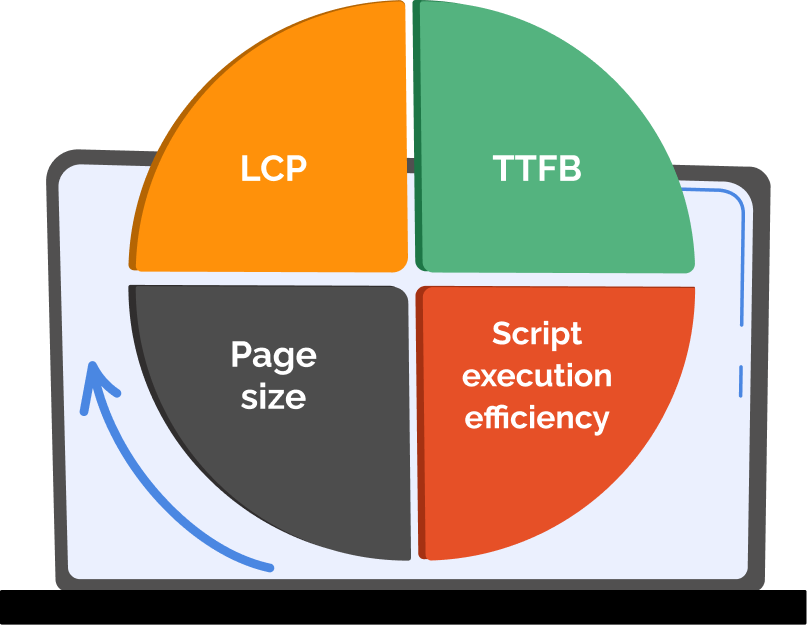
Performance (20 Points)
Front-end performance metrics measure how quickly a page loads and becomes usable for visitors. Factors such as server response time, page weight, and script execution efficiency directly impact user experience and overall page responsiveness.
LCP
TTFB
Page size
Script execution efficiency
Data Integrity (20 Points)
Reliable analytics and tracking systems are essential for understanding user behavior and marketing performance. Proper configuration ensures that events, conversions, and attribution data are captured accurately and consistently across analytics and CRM platforms.
GA4 configuration
Event tracking accuracy
CRM integration
Attribution consistency

Conversion Structure (20 Points)
Lead generation performance often depends on how clearly a website guides users toward action. Elements such as call-to-action visibility, form usability, page hierarchy, and trust indicators influence how easily visitors can complete key interactions.
CTA clarity
Above-the-fold positioning
Form friction
Social proof placement

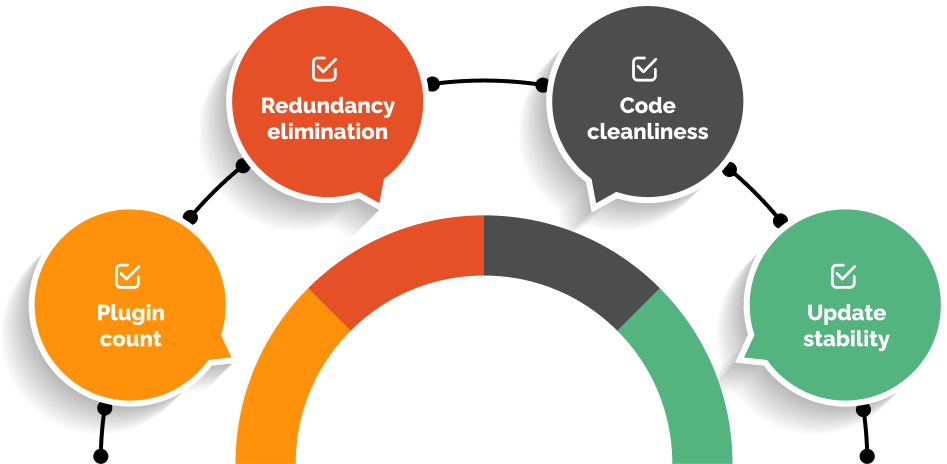
Technical Simplicity (20 Points)
Maintaining a streamlined technical architecture helps reduce maintenance overhead and performance conflicts. Sites with fewer redundant components, cleaner codebases, and stable update processes tend to operate more reliably over time.
Plugin count
Redundancy elimination
Code cleanliness
Update stability
Scoring Bands
Final scores fall into defined performance ranges that indicate the overall operational health of a website. These bands help quickly identify whether a site is optimized, moderately efficient, or experiencing deeper architectural limitations.