
Website estimates: how to get accurate website cost estimates

Website estimates: how to get accurate website cost estimates
If your search intent is “website estimates,” you want a reliable way to turn business goals into a realistic cost range and clear vendor deliverables. This guide gives a short answer first, then a practical framework you can use to prepare a request for estimate (RFE), evaluate quotes, and reduce budget risk.
Primary answer — what you need right now
If you need a quick takeaway: estimates vary because projects with the same high-level goal can differ radically in scope, integrations, content effort, and risk. The fastest path to an accurate estimate is to stop asking for a ballpark number and instead supply a focused RFE that defines goals, required pages/features, integrations, and content responsibilities. Use the process below to get proposals that are comparable and actionable.
Why website estimates feel inconsistent
Two core reasons make estimates look inconsistent:
- Scope ambiguity — “a business website” can mean anything from a single landing page to a complex application with memberships, commerce, or custom workflows.
- Delivery approach — template-based builds, agency customization, and fully custom development have very different time, risk, and QA characteristics even when the outcome looks similar to an endpoint user.
Once you separate scope from delivery method and list specific technical or marketing constraints, the range collapses and quotes become comparable.
Primary cost drivers (what changes the price)
- Scope and page templates: number of unique templates (homepage, product page, checkout, blog, etc.).
- Features and complexity: e-commerce, memberships, booking systems, or custom business logic.
- Integrations: CRM, payment gateways, marketing automation, external APIs, or inventory systems.
- Design effort: custom UI/UX vs. theme customization or an off-the-shelf template.
- Content: whether copy, product information, and media are provided or created by the vendor.
- Performance, security, and compliance: hosting tier, SLAs, GDPR/PCI requirements, and accessibility work.
- Timeline and risk: fixed deadlines, parallel dependencies, or unknown legacy systems increase cost.
- Ongoing services: maintenance, monitoring, SEO, or marketing retainers change total cost of ownership.
Decision framework: which delivery path fits your project?
Choose the delivery approach that matches your needs and risk tolerance. The table below helps match business needs to a recommended delivery path.
| Business need | Delivery path | When to choose |
|---|---|---|
| Simple brochure or single-service landing | Template or DIY | Limited budget, few integrations, able to provide content |
| Lead generation, conversion-focused marketing | Small/marketing agency or customized template | Need design, conversion optimization, CRM integration |
| E-commerce, membership, or custom workflows | Custom development agency | Complex integrations, custom data models, or strict SLAs |
How online pricing tools and calculators help — and their limits
Pricing tools are useful for early-stage budgeting and internal approvals. Use them to generate scenario ranges (basic, standard, complex) so stakeholders share a starting expectation. But calculators cannot replace scoped proposals because they cannot inspect your content quality, legacy data, or specific third-party APIs and requirements.
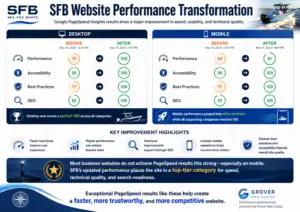
If you want to quantify technical and marketing priorities, consider running a performance or readiness check before requesting estimates. Our Grover Performance Index calculator and the Website Performance Score Explained content can help prioritize performance trade-offs that affect cost and hosting choices.
Practical RFE checklist — what to include when you ask for estimates
Vendors can only estimate reliably if you give clear inputs. Include the items below in your RFE or brief:
- Business objective and primary conversion actions (e.g., contact form, demo, purchase).
- Target audience and traffic expectations (approximate, if known).
- List of required pages and unique templates (homepage, product page, checkout, blog, member dashboard).
- Known integrations and required data flows (CRM, payment, shipping, inventory, marketing tools).
- Content responsibilities: who provides copy, images, products, and data migration?
- Design examples and reference sites showing desired look and interactions.
- Performance, security, and compliance expectations (page speed targets, PCI, accessibility level).
- Timeline and launch constraints; whether a phased approach is acceptable.
- Budget band or procurement process details, if relevant to the proposal format.
How to evaluate and compare vendor estimates
A quote is only as useful as its assumptions. Compare proposals using these checkpoints:
- Scope clarity: Are deliverables and acceptance criteria explicitly listed per milestone?
- Integration specifics: Are third-party systems named and responsibilities assigned for API access and test data?
- Content scope: Does the price include copy, photography, product import, or is that an extra?
- Change control: How are scope changes handled — fixed-rate change orders or hourly rates?
- Testing and quality assurance: What testing levels are included (unit, UAT, cross-browser, accessibility)?
- Post-launch support: Warranty period, SLA options, ongoing maintenance costs.
- Payment schedule: Are payments milestone-based and tied to acceptance criteria?
Practical ways to reduce cost and estimation uncertainty
- Prioritize a Minimum Lovable Product (MLP): scope essential features for launch and plan iterative improvements.
- Provide content early: supplying copy and assets shortens delivery time and vendor effort.
- Choose proven platforms for common needs: established commerce platforms or CMSs reduce custom development hours.
- Phase work: split discovery, build, and optimization into phases with clear milestones.
- Fund a short paid discovery if integrations or legacy systems are unclear: discovery reduces estimation risk and often saves time overall.
Qualitative project profiles (examples to help you classify your project)
- Profile A — Straightforward brochure site: Few pages, no integrations, client provides content, theme customization acceptable.
- Profile B — Sales and lead-gen site: Custom templates, CRM integration, conversion tracking, several rounds of CRO-driven design.
- Profile C — Commerce or membership platform: Catalog or products to migrate, payment and fulfillment integrations, custom checkout flow, and ongoing operations support.
Label your project with a profile like the above before requesting quotes. Vendors will respond more accurately when they see which profile you expect.
Sample RFE template (use copy-paste and edit)
Title: [Company] Website Build — RFE
Summary: One-paragraph business objective and launch goals.
Must-have deliverables: List key templates, integrations, and conversion events.
Content: Who provides copy and assets; required migration notes.
References: URL examples and style notes.
Timeline: Target launch and acceptable phased approach.
Budget: Optional band or procurement details.
Decision process: How and when you will compare proposals.
When to pay for discovery
Discovery is recommended when integrations, data migration, or business logic are unclear. A short paid discovery reduces surprises in the build phase and helps vendors give firm fixed-price proposals rather than large contingency buffers.
Vendor red flags to watch for
- Vague deliverables or proposals without acceptance criteria.
- Estimates that vary widely without explanation of scope differences.
- No mention of testing, backups, or security hardening.
- Payment terms that demand most of the fee upfront without milestone-based acceptance.
Tools and Grover resources to prepare and compare estimates
Use diagnostic tools and content that help quantify priorities before soliciting quotes. Helpful starting points:
- Website Performance Score Explained — understand how performance requirements affect architecture and cost.
- Grover Performance Index calculator — a tool to tie technical priorities to outcomes and help prioritize spend.
- Grover Web Design services — overview of delivery options if you prefer an agency path.
- Custom web development and SEO services — service pages that explain specialized capabilities and ongoing support options.
Expanded FAQ
How accurate are online website cost calculators?
They are accurate for directional budgeting and comparing high-level scenarios, but not for final procurement. Calculators assume typical integrations and content quality and cannot test your legacy systems or custom API needs.
How long should I expect the quoting process to take?
For a well-defined RFE, vendors typically return useful proposals within a week or two. Complex projects that require discovery or technical investigation may require a paid discovery phase before a firm quote can be provided.
Do I always need a fixed-price contract?
Fixed-price contracts work well when scope is stable and acceptance criteria are defined. For projects with evolving requirements, consider a hybrid approach: phase one fixed-price discovery and build, then a time-and-materials or retainer model for ongoing work.
How does site performance affect cost?
Performance affects architecture, hosting, and optimization effort. High-performance targets may require specialized CDN setups, advanced caching strategies, or additional engineering effort, which increases initial and ongoing costs. See our performance guidance to align expectations.
What should I do next to get accurate estimates?
Prepare the RFE checklist above, label your project with a qualitative profile, and decide whether to fund a short discovery. If you want help validating scope or preparing an RFE, book a short review with Donny or use the Grover tools linked above to prioritize technical needs.

Talk with Donny about your website estimate
Get a focused 20-minute review of your project scope, guidance on the right delivery path, and a realistic approach to estimates.
Next steps
Use the RFE checklist and decision framework above to prepare a short brief. If you want a guided review of your scope before soliciting quotes, book Donny for a 20-minute review or run the Grover Performance Index calculator to quantify technical priorities. When comparing proposals, focus less on headline price and more on scope clarity, integration responsibilities, and post-launch support to get the estimate that matches your timeline and risk tolerance.